

Turn Your Baked Desserts into Winter Ice Cream Toppings
Author: Admin Date Posted:14 June 2026

Winter Ice Cream Dishes The baked desserts your kitchen already makes become winter ice cream toppings when the ice cream leads and the warm component follows.
You already bake brownies, press waffles, and assemble fruit crumbles. In winter, those items headline the plate. The ice cream sits beside them, softening into a puddle, doing very little beyond filling space and justifying the price. All three could be working as warm winter ice cream toppings.
But the best version of each of these dishes is not the one where the ice cream plays a supporting role. It is the one where the warm baked component comes to the ice cream. Brownie pieces broken directly onto dark chocolate ice cream. Crisp waffle shards pressed into salted caramel. Warm streusel and fruit compote spooned over vanilla. In each case, the ice cream is the centrepiece. The warm element is what makes it a winter dish.
These are not garnishes. They are complete winter ice cream dishes; built around components you already know how to make.
Warm Brownie Pieces Over Dark Chocolate Ice Cream
When you plate a brownie with ice cream on the side, you are making a brownie dish. The ice cream is there to cut the richness, to provide a cool contrast, but the brownie is the point of the plate, and the ice cream is decorative. Within a few minutes the ice cream has melted into a pool of cream around the base, and whatever temperature contrast existed is gone.
Put the brownie on the ice cream and the whole thing changes. Now the ice cream is the foundation. The brownie brings its heat, its chew, its deep cocoa weight directly into the bowl, and every spoonful delivers both together. The ice cream does not melt into a puddle because the warm pieces are small enough to create contrast without overwhelming the cold mass beneath them. The dish keeps its structure from first spoonful to last.
Baking for topping use
The brownie you bake for this dish is not the same one you would plate as a dessert. It needs to be thinner, around two centimetres rather than four, so the pieces are the right scale against the ice cream. Push the ratio toward fudgier: more chocolate, more butter, less flour. You want a piece that keeps its shape when broken but yields immediately in the mouth, so it merges with the ice cream rather than sitting on top like a biscuit.
Bake the slab in a lined sheet tray, cool it just enough to handle, and break it by hand into rough, irregular pieces. The hand-broken edges matter. Machine-cut squares sit too neatly against ice cream and look manufactured. Irregular pieces create surface area that catches sauce, and the uneven shapes mean no two spoonfuls are identical. Each piece should be small enough to eat in one or two bites but large enough to register as its own element in the bowl.
Building the dish
Start with a generous portion of dark chocolate ice cream in a solid bowl or coupe glass. Place two or three warm brownie pieces directly onto it, pressing them gently so they make contact with the surface. The heat from the brownie will begin to soften the ice cream where the two meet, creating a thin layer where warm fudge and cold cream merge into something neither delivers alone.
A drizzle of hot fudge sauce pulls everything in the bowl together with a ribbon of warm chocolate.
Finish with a few pieces of crushed chocolate honeycomb scattered over the top. The honeycomb does one thing the brownie cannot: it is light, aerated, and brittle where the brownie is dense, fudgy, and chewy. The contrast between the two is what lifts the bowl. Dense and light. Chewy and brittle. Two chocolate textures that are nothing alike.
This is a rich, dark, deeply chocolatey winter dish. It reads as indulgent before your customer picks up a spoon, and it delivers on that promise in every mouthful. A customer who would not order a bowl of chocolate ice cream on a cold night will order this, because it is no longer just ice cream. It is a warm chocolate dish that happens to be built on ice cream.
Waffle Crisps Over Salted Caramel Ice Cream
When you lay a waffle flat on a plate with ice cream on top, you are serving a breakfast that wandered onto the dessert menu. It fills space, it looks generous, and it goes soft within minutes as the melting ice cream soaks into the grid pattern. By the time your customer is halfway through, the base is damp and limp and the textural promise the dish made when it arrived has entirely disappeared.
Waffle prepared as a topping is a different matter. It becomes a crisp, a shard, a piece of concentrated buttery crunch that keeps its texture because it is sitting on the ice cream rather than under it. The surface area in contact with the cold cream is small enough that each piece stays intact through the entire dish. Your customer gets crunch in the last spoonful, not just the first.
Pressing and crisping
Press the waffle thinner than you normally would. If you are using a standard waffle iron, press the lid down firmly and hold it longer than usual to drive out more moisture and develop deeper caramelisation. If you have a pizzelle iron, even better. The thinner the waffle, the crispier it becomes and the longer it lasts.
While the waffle is still warm and pliable, cut it into batons or shards with a sharp knife or snap it by hand into irregular pieces. Let the pieces cool fully and crisp before service, then keep them in a low oven to stay warm and dry. The finished crisps should snap cleanly when you break one. If they bend, they are too thick or too moist.
Building the dish
A portion of salted caramel ice cream in a wide bowl or coupe. Press two or three waffle crisps into it at angles so they stand upright or lean against each other. The visual effect is striking: golden shards rising out of the amber ice cream, catching the light differently depending on the angle.
The waffle flavour is buttery and lightly caramelised, a natural partner for salted caramel. But where the ice cream is smooth and cold, the waffle is warm and entirely crunch. There is no chew here, no softness. It is all shatter and snap, and that clean textural contrast against the yielding cream is what makes the dish feel precise rather than heavy.
Finish with a scatter of caramel popcorn pieces, broken smaller if they are too large for the scale of the bowl. The popcorn is airy and puffed where the waffle is flat and dense, so the two crunch differently in the mouth. The caramel coating on the popcorn echoes the butterscotch notes in the ice cream, pulling the flavour together, while the salt in both the popcorn and the ice cream keeps the sweetness in check. The bowl has crunch at two different scales and two different densities, and both are warm against the cold cream.
This is a lighter, more elegant winter dish than the brownie. It suits a customer who wants something sweet and warming but not heavy, and the way the crisps stand in the ice cream gives it a visual sharpness that reads as premium on a menu board or in a photograph.
Warm Streusel and Fruit Compote Over Vanilla Ice Cream
A fruit crumble is a single baked dish: fruit on the bottom, crumble topping on top, everything cooked together in one vessel. For a winter ice cream dish, you separate it into two distinct preparations that each do better work on their own.
The crumble topping becomes a streusel, baked independently. The fruit becomes a warm compote. Each is prepared with more control and more precision than a composite crumble allows, and together over vanilla ice cream they deliver everything a crumble promises, the buttery crunch, the warm fruit, the contrast of hot and cold, without the heaviness of a full baked dish.
Making the streusel
Rub cold butter into plain flour, rolled oats, brown sugar, and a pinch of salt until the mixture forms rough, uneven clumps. Spread these across a lined sheet tray in a single layer and bake until golden and fragrant, turning once for even colour.
Baking the streusel separately is the key. In a traditional crumble, the topping bakes above steaming fruit, which means some patches go golden while others stay pale and damp where the steam broke through. On its own sheet tray, every piece bakes evenly. You control the colour and the crunch precisely, and the result is a topping where every cluster is golden, buttery, and crisp all the way through.
Once baked, break the sheet into rough clusters of different sizes. Some should be large enough to register as individual pieces against the ice cream. Others should be smaller, almost rubble, to fill the gaps between larger clusters and create a continuous textured layer across the top.
NB: an alternate ready made product that substitutes nicely for a stueusel is the Super Crunch nut free granola
Making the compote
Choose fruit with enough acidity to stand up against the sweet streusel and the rich ice cream. Apple and rhubarb is the natural winter combination: the apple provides body and sweetness; the rhubarb provides sharpness and colour.
Dice the apple, cut the rhubarb into short lengths, and cook them gently with a little sugar, a squeeze of lemon juice, and a splash of water. The compote is ready when the apple is soft but still holds some shape and the rhubarb has collapsed into a tart, rosy sauce around it. It should be loose enough to pour from a small jug but thick enough to cling to the side of the ice cream rather than running straight to the bottom of the bowl.
Building the dish
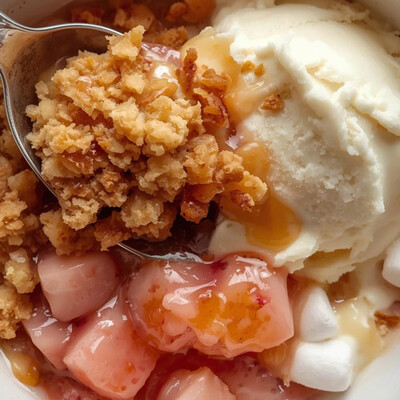
A portion of vanilla ice cream in a bowl. A generous spoonful of warm streusel over the top, pressed gently so the clusters sit against the surface and begin to soften at their base where cold meets warm. A pour of warm apple and rhubarb compote down one side, so it pools beside the ice cream, and your customer can take as much fruit as they want with each spoonful.
The streusel brings buttery, oaty crunch that crumbles and mixes with the ice cream as they eat through it. The compote brings fruit brightness, acidity, and warmth. The vanilla ice cream underpins both, its clean dairy richness letting the streusel and the fruit come through clearly. Together it tastes like the best parts of a crumble, the golden top and the warm fruit, without the dense baked base that makes a full crumble feel heavy after a few bites.
Tuck a few mini marshmallows between the streusel clusters. They begin to soften against the warm compote, creating small pockets of chewiness between the crunch of the streusel and the smooth cold of the ice cream. The pink and white colours lift the golden and amber tones of the dish without adding visual clutter. One small element, doing one textural job: chew where everything else is either crunchy or smooth.
For a customer who wants warmth and comfort without heaviness, and fruit without sacrificing the indulgence of ice cream, this is the dish.
The baked components you already produce are the foundation for a winter ice cream menu that keeps the ice cream at the centre of the plate. The brownie dish is rich, dark, and deeply chocolate. The waffle dish is crisp, elegant, and visually striking. The streusel and compote dish is textured, fruity, and layered. Each one is a complete winter ice cream dish, not a dessert with ice cream on the side.
For a broader guide to building winter ice cream menus with the right flavour, sauce, and topping combinations, see Boost Winter Ice Cream Sales with Smarter Serves. Opera Foods supplies the dessert toppings that finish these dishes, in bulk, with overnight delivery to ice cream parlours and dessert bars across Australia.